How an Elevator Traction Machine Works
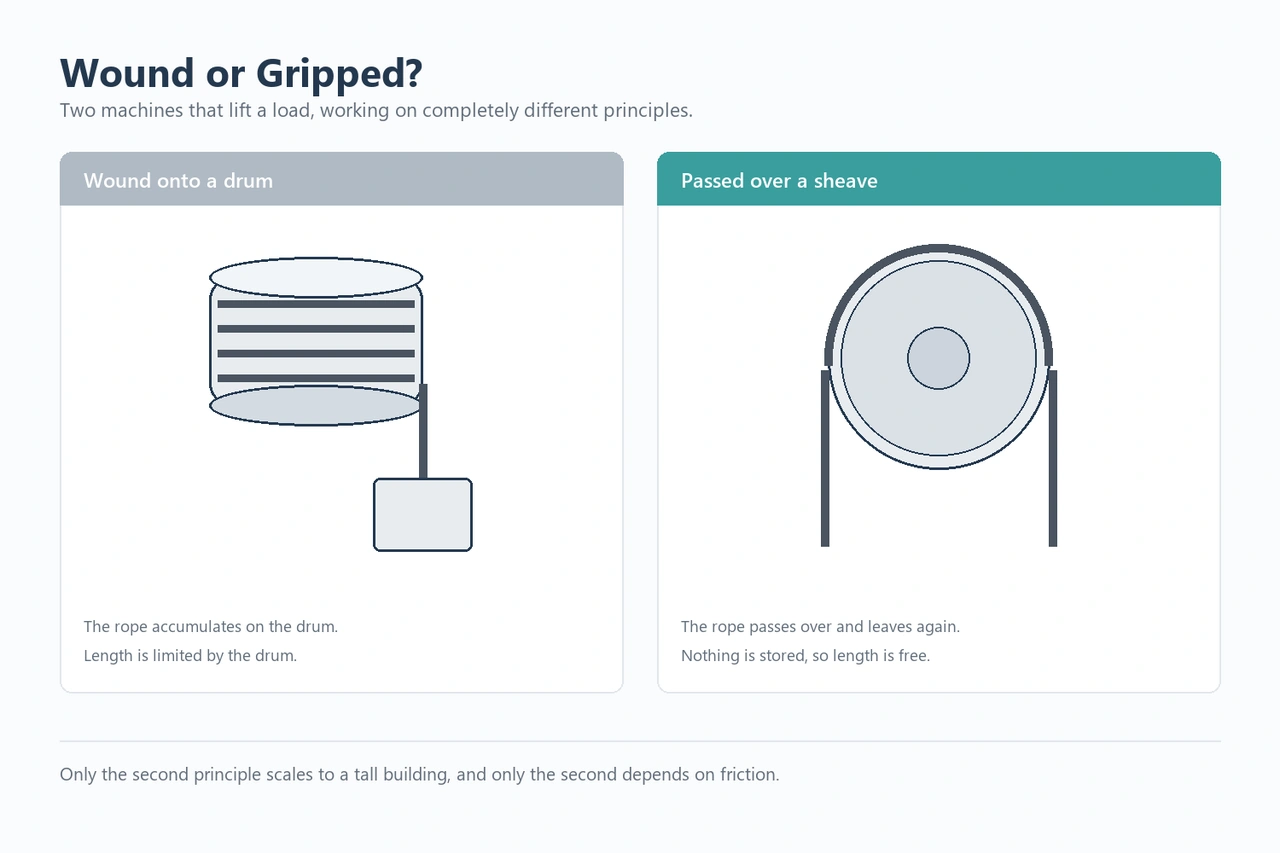
It Grips the Rope, It Does Not Wind It
The Load Path
To see how an elevator traction machine works, follow the load. Four things carry it: the car, the counterweight, the ropes, and the sheave.
One end of the hoisting ropes is attached to the car, the other end to the counterweight. The ropes pass over the traction sheave, and the weight hanging on each side presses them into the grooves. That pressure is what produces the grip.
When the sheave turns, the two sides move in opposite directions. The car rises as the counterweight descends, and the counterweight rises as the car descends. The counterweight is not there to lift the car — it is there to balance it, so the motor never has to move the full weight of the car and its passengers.
Deflector sheaves are added when the car and counterweight need more space between them, or when the layout needs more rope wrapped on the drive sheave.
Inside the Machine: Five Parts
| Part | What it does |
|---|---|
| Motor | Produces the torque. Gearless machines use a permanent-magnet synchronous motor, with the sheave mounted directly on the rotor and no gearbox between them. |
| Traction sheave | The grooved wheel. Groove shape and undercutting determine how firmly the rope is pinched. |
| Brake | Holds the machine at rest. It is spring-applied and electrically released, mounted on the machine, so losing power applies the brake instead of releasing it. |
| Encoder | Reports rotor position and speed to the drive, so the motor is controlled in a closed loop rather than open loop. |
| Drive | Converts the supply into the current the motor needs, and runs the start, stop and levelling profile. |
A geared machine adds a gearbox between motor and sheave. A gearless machine removes it, which makes the assembly more compact and eliminates gear oil.
The Start Sequence
-
The drive builds torque against the applied brake, holding the car still.
-
The brake releases. Torque is already present, so there is no rollback.
-
The car accelerates, then runs at speed.
-
Before stopping, speed is brought back near zero while the brake is still open.
-
The brake applies, and torque is removed.
Why the Roping Arrangement Matters
What Makes a Machine Slip
-
Worn or polished grooves, which reduce the pinch on the rope.
-
Contamination, particularly oil or grease reaching the groove.
-
A counterweight that is out of balance, which widens the tension difference between the two sides.
-
Rope stretch, or a rope specification that does not suit the groove profile.
-
On long travel, the weight of the ropes themselves changes as the car moves. A compensation device is used to keep the two sides balanced through the full travel.
FAQ
The Short Version
Elevator Door Sensor Types: How to Identify and Choose
Related Article