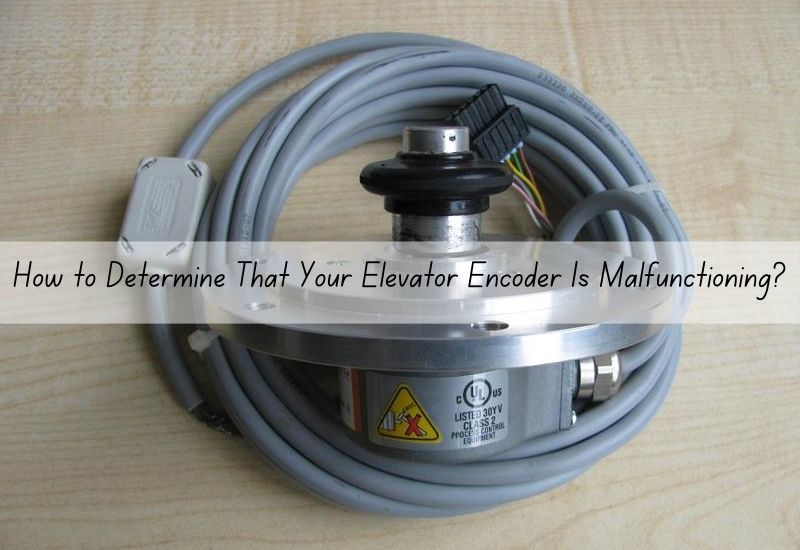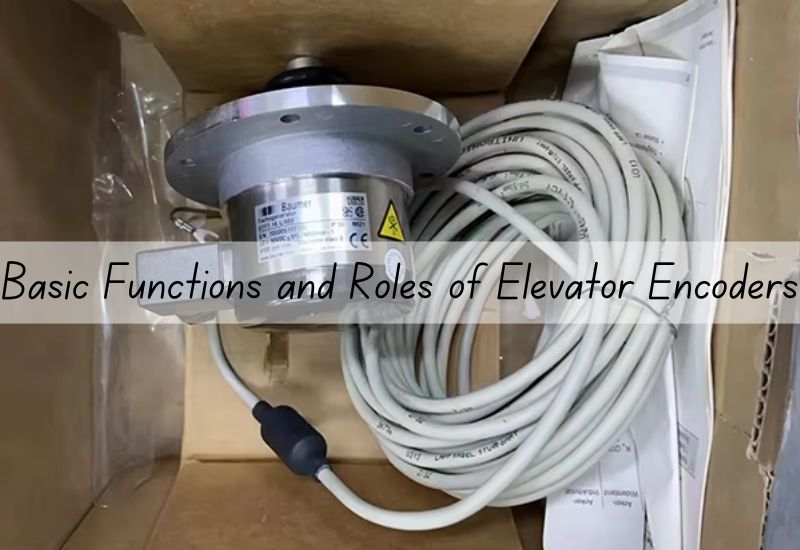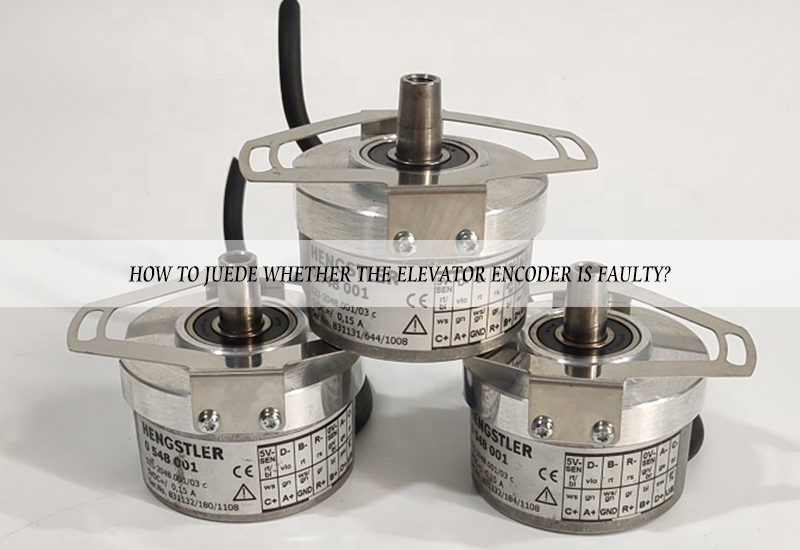
What Does an Elevator Encoder Do?
An elevator encoder tells the drive three things it cannot work out for itself. Which way the motor turns, how fast, and how far it has gone.
Without that signal the drive has no idea whether the car is moving or standing still. It cannot hold a level landing, cannot control acceleration, and cannot stop before the counterweight reaches the buffer.
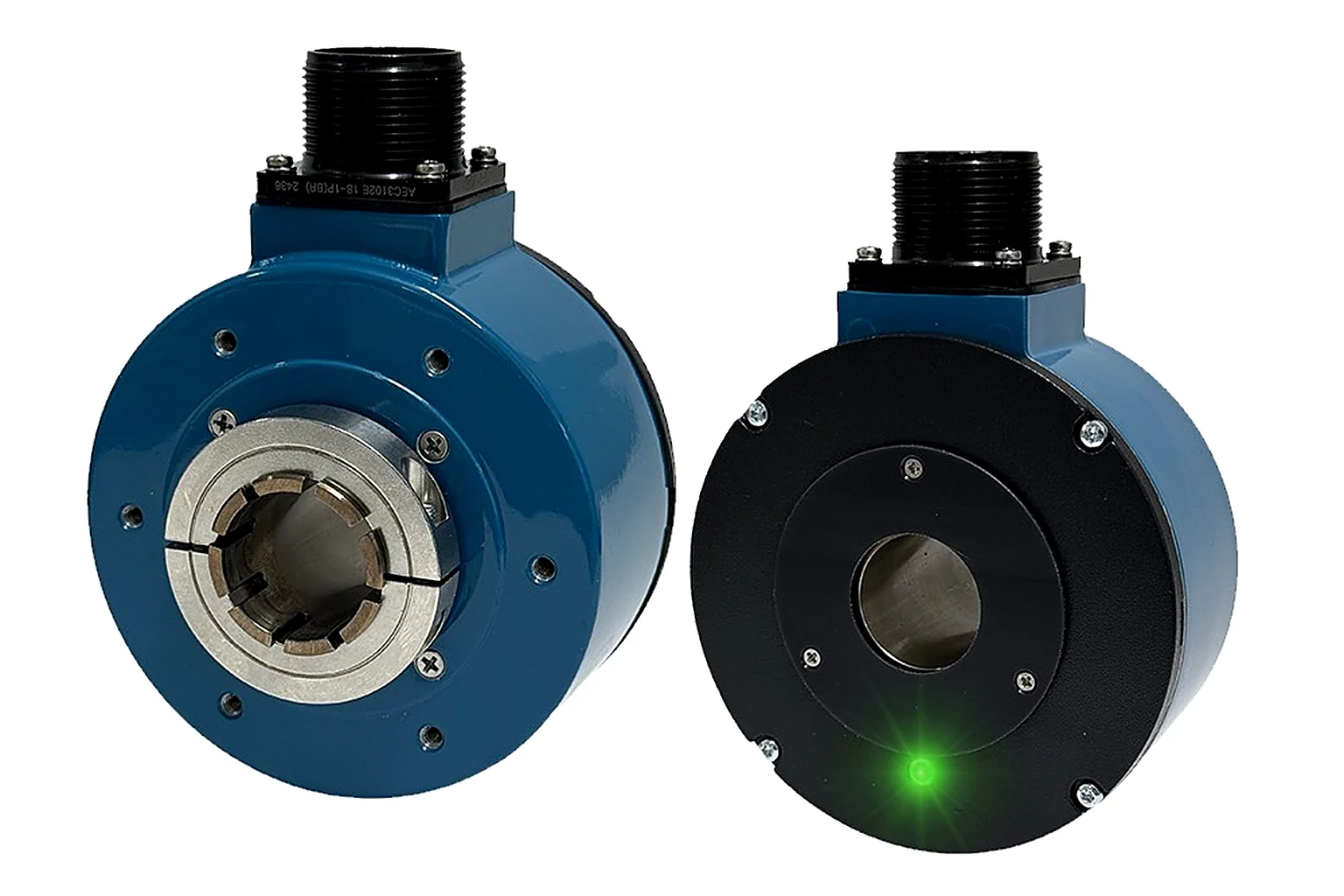
What does an elevator encoder do
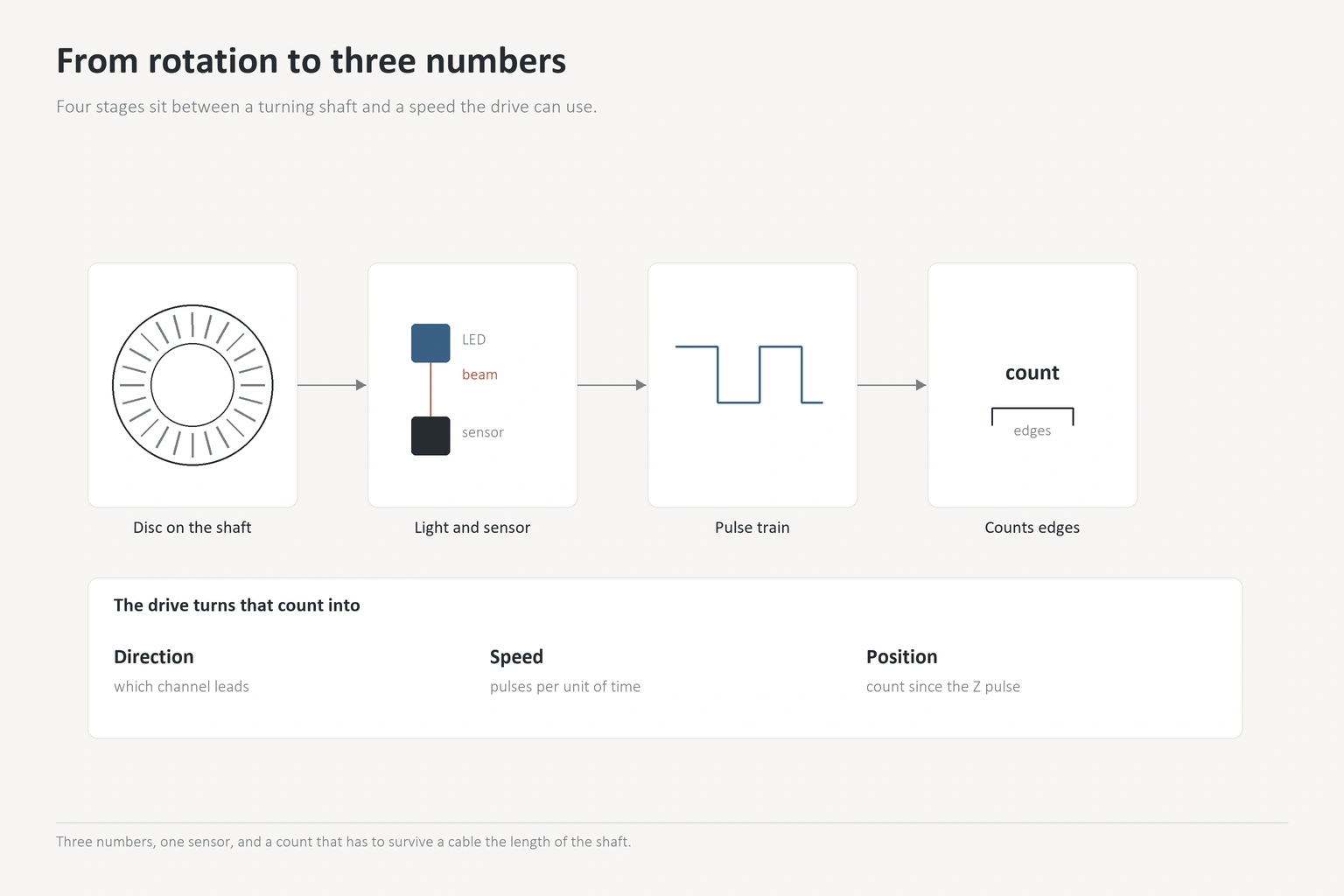
It converts rotation into electrical pulses. Every time the shaft turns through a fixed angle, the encoder emits a pulse. The drive counts the pulses and the count becomes distance.
Three quantities come out of one signal.
| Quantity | How the drive gets it | What it is used for |
|---|---|---|
| Direction | Which channel leads | Deciding whether the car is going up or down |
| Speed | Pulses per unit of time | Closing the speed loop, every few milliseconds |
| Position | Total pulses since a reference | Levelling, floor table, slowdown points |
That is the whole function. Everything else is a variation on that. The question is how the three quantities are produced, and how reliably they survive the cable.
What is the purpose of elevator encoder
The purpose is closed-loop control. A lift is not driven at a fixed voltage for a fixed time, because the load changes.
An empty car and a full car need different torque for the same acceleration. A cold machine room and a hot one need different compensation. A drive that cannot measure the result cannot correct for any of it.
Four things depend on the measurement.
Leveling. The car has to stop within a few millimetres of the floor, every time, at any load. The drive slows down as the pulse count approaches the target.
Normal acceleration and braking. The profile is a curve, not a step. Following it needs a speed reading many times per second.
Overspeed protection. If the measured speed exceeds the profile, the drive removes torque and the machine brake sets. Without measurement there is nothing to compare against.
Creep. At very low speed the motor turns a few degrees per second. Only a high-resolution signal can see that motion at all.
How an encoder works in an elevator
The mechanism is simple enough to describe in five steps.
- A disc is fixed to the motor shaft. It carries a ring of fine slots, evenly spaced, and one extra slot on its own track.
- A light source sits on one side, a sensor on the other. As the disc turns, the slots pass the beam and the sensor sees light and dark.
- The light and dark become a square wave. Each cycle of the wave is one pulse.
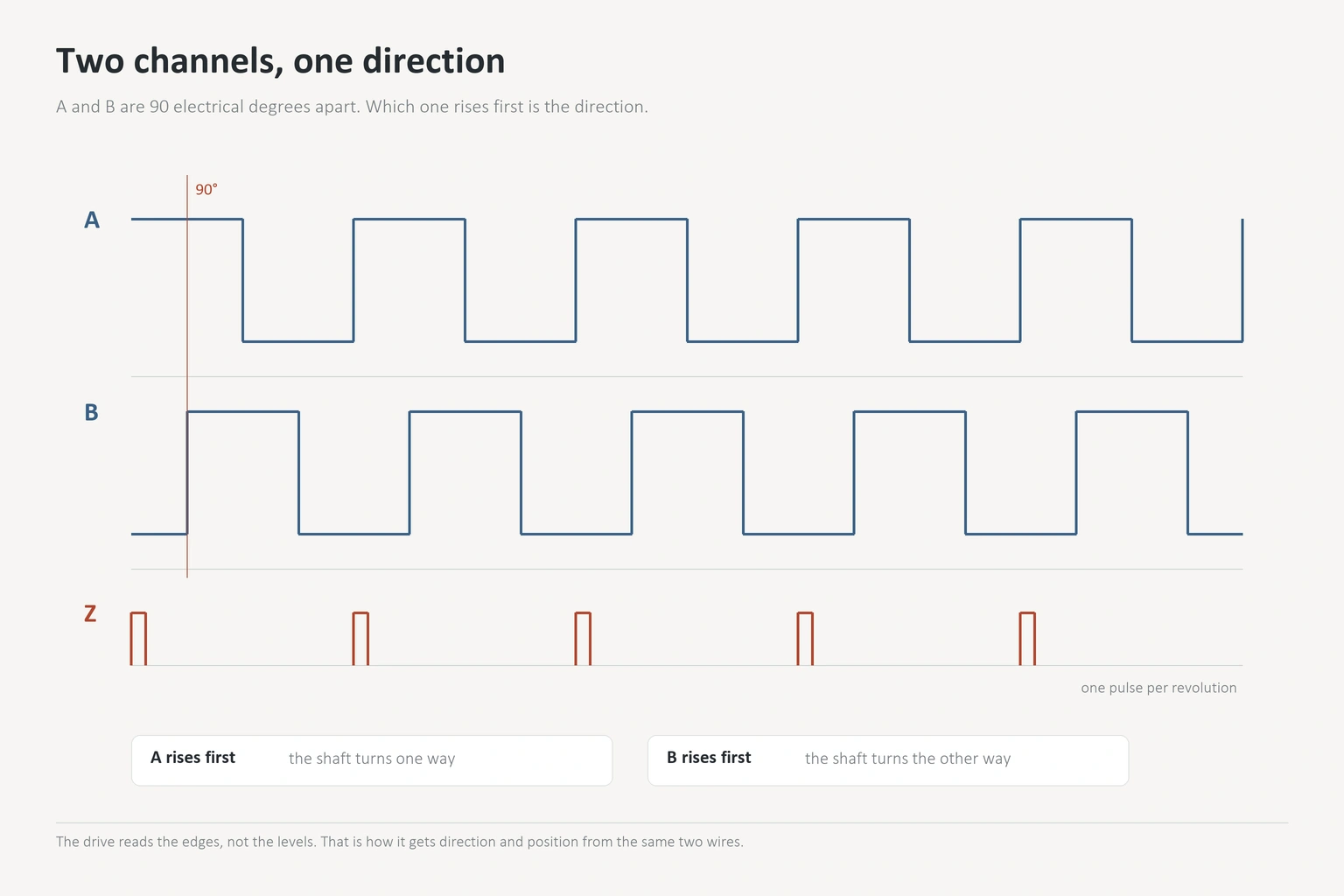
- A second sensor, offset by a quarter of a slot, produces a second wave. That offset is what makes direction measurable.
- A third track produces one pulse per revolution. The drive treats it as a reference mark.
Some encoders use a magnetic ring and a sensor instead of light and slots. The signal at the end is the same. The difference shows up in what the encoder tolerates: oil, dust, heat and vibration.
Why there are two channels
One channel tells you speed. Two channels tell you direction, and direction is not optional.
The two waves are 90 electrical degrees apart. If A rises before B, the shaft is turning one way. If B rises before A, it is turning the other. The drive compares the edges and gets both the direction and a position count that goes up or down.
The index pulse, Z, arrives once per revolution. It gives the drive a fixed point to count from, so a small error cannot accumulate into a whole floor.
| Signal | What it adds |
|---|---|
| A only | Speed, but no direction |
| A and B | Direction and a bidirectional count |
| A, B and Z | A repeatable reference point once per turn |
From pulses to speed
The drive does not measure speed. It measures time between pulses, or pulses within a fixed window, and divides.
That has a consequence worth knowing on site. At high speed there are many pulses per window, so the reading is smooth. At very low speed there may be two or three pulses in the window, and the reading becomes coarse. This is why a lift can feel smooth at full speed and still judge a landing badly. Resolution that is generous at 1.5 m/s is thin at 0.05 m/s.
Resolution is set by the pulse count per revolution, but accuracy is set by the mounting. A high-resolution encoder on a loose coupling reports precise numbers that are precisely wrong.
What happens when the signal is lost
The drive notices within one control cycle, and the behaviour is deliberate rather than accidental.
| Condition | Drive response |
|---|---|
| No pulses while torque is applied | Speed fault, torque removed, brake sets |
| Pulses that stop matching the expected profile | Over-speed or following-error fault |
| A and B lost, Z still present | Position fault, usually on the next run |
| Intermittent pulses | Jerking, then a fault, often after weeks |
In every case the lift stops and stays stopped until it is reset. That is the correct design: a lift that guesses its speed is more dangerous than one that refuses to move.
The pattern on site is worth recognising. A dirty disc rarely fails completely. It produces a fault every few days, always in the same part of the shaft. Each time it clears on reset. That is the window in which the encoder can still be saved by cleaning and re-sealing.
Where the encoder is on the lift
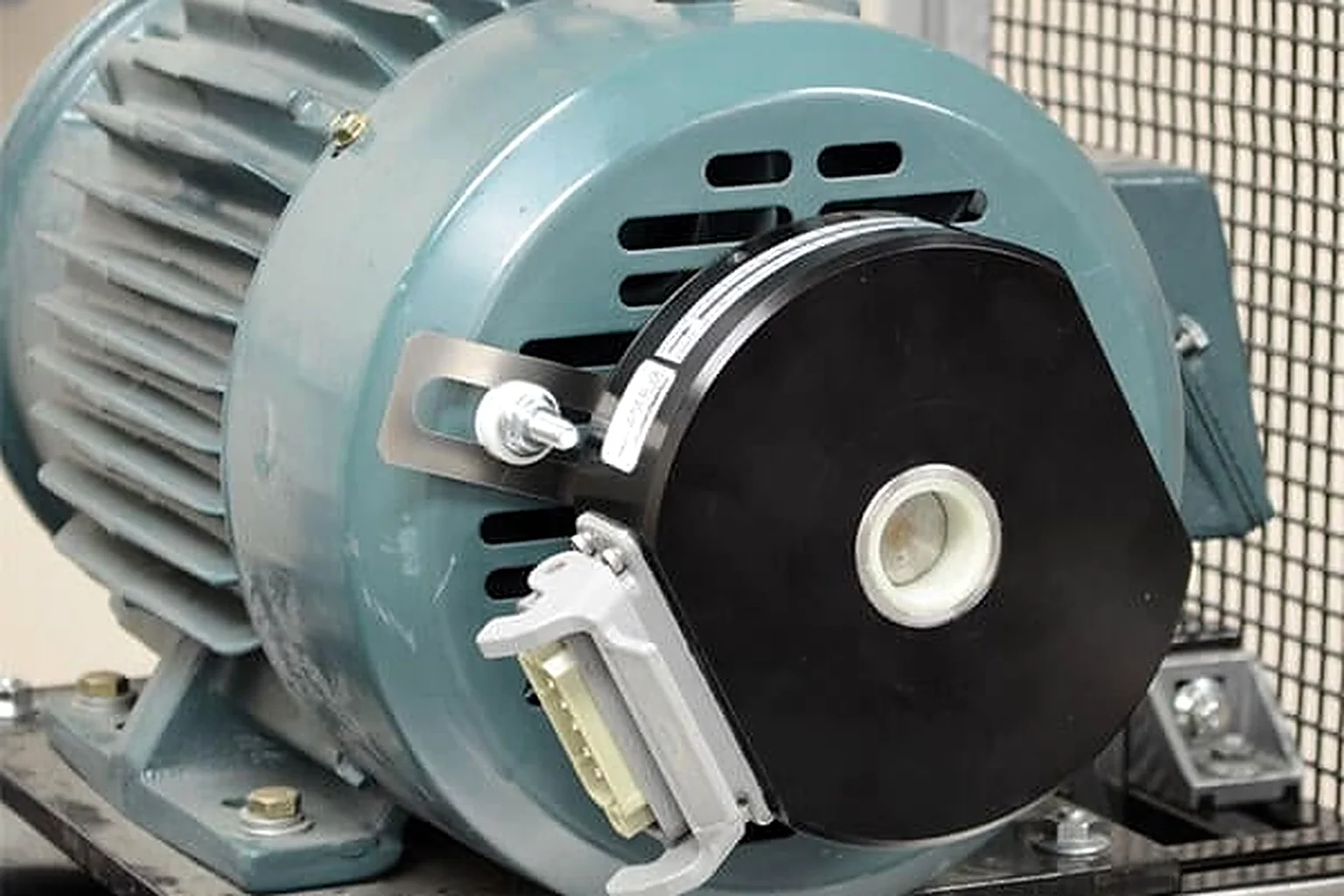
The one most people mean sits on the traction motor. Two other positions exist and are often confused with it.
| Position | What it measures | Confused with |
|---|---|---|
| Traction motor | Rotor speed and direction | Nothing: this is the drive feedback |
| Door operator | Door leaf position | Door safety sensors, which detect people |
| Car position system | Height in the shaft | The motor encoder, which measures the machine |
The third is the one that causes arguments. A car position system measures the building. A motor encoder measures the machine. When the two disagree, the lift stops even though neither is broken. Replacing the encoder will not fix it.
In one paragraph
An elevator encoder is a small measuring device that turns rotation into two pulse trains. The drive compares them to get direction, counts them to get position, and times them to get speed. Everything a passenger notices depends on that count being right. A smooth start and a level stop both begin there.
Specify an encoder by shaft size, pulse count and output stage. Fit it with a rigid coupling and a shielded cable. It then works for years without appearing in a fault log.
If you are replacing one, the label on the old unit carries most of the answer. POTENSI supplies incremental, absolute and kit encoders for lift duty, and the interface boards they connect to. Send a photo of the label, the shaft measurement and one picture of the mounting. The match comes back confirmed, with a price and a delivery date.
Adding an Elevator Air Conditioning System to an Existing Lift
Related Article