Elevator ARD: Automatic Rescue Device Guide & Specs
author: Cloe
2026-10-09
When the power fails, a lift stops where it is. If passengers are inside, they stay inside until someone reaches them. An elevator ARD exists to prevent that. It is a battery-backed unit that moves the car to the nearest floor and opens the doors, without waiting for a technician.
This guide is written for people who have to specify, buy or approve one. It explains what an elevator ARD is, and how the automatic rescue device works. It covers the specifications on the datasheet, how to size a unit for a particular lift, and what decides the price. No marketing language, and no numbers that cannot be traced to a real source.
What Is an Elevator ARD?
ARD stands for Automatic Rescue Device. Some suppliers use ERD, which stands for Emergency Rescue Device. Both names describe the same job.
What is ARD in an elevator, in plain terms? It is a backup power and control unit.
An ARD drives the lift to the nearest floor at low speed when mains power fails, and opens the door so passengers can walk out.
The unit is sometimes called an elevator automatic rescue device, and sometimes an elevator emergency automatic rescue device, because it is sold as one box. It contains a control module, a battery pack and a power stage. It works with the lift controller rather than replacing it.
An ARD for elevators is not a general power supply. Its output is sized for one job: moving the car to a landing.
What an elevator ARD does
The ARD system in an elevator does three things during a power failure:
-
It detects that the main supply has gone.
-
It runs the car to the nearest floor using battery power.
-
It levels the car and opens the doors.
What an elevator ARD does not do
This part matters, because many buyers expect more than the device can give.
-
It does not keep the lift running normally. An ARD is for rescue only. It performs one short trip, then stops.
-
It is not a fire evacuation function. Fire operation and evacuation are separate control functions with their own requirements.
-
It is not a building UPS. It does not power lighting, air conditioning or other building loads.
-
It does not drive the lift at full speed. Rescue travel is deliberately slow.
Who fits an elevator ARD
Four groups are usually involved: lift manufacturers who build it into a new lift, modernization contractors who add it to an existing one, building owners who need to comply with local rules, and facility managers who have to keep it working.
Why Power Failure Is the Real Problem
Power failure is the most common reason people get trapped in a lift. It is also the most predictable.
Here is what actually happens when the supply drops:
-
The car stops wherever it was, which is often between two floors.
-
The lights may go out. The car fan stops.
-
The trapped person has to use the alarm or the intercom and then wait.
-
A technician has to travel to the building, find the car, and bring it to a floor. In a busy city that can take a long time.
The costs are not only discomfort. Building owners deal with complaints, emergency call-out fees, and in some markets penalties if they cannot respond in time. For hotels, hospitals and shopping centers, an entrapment during business hours is a visible failure.
An ARD changes the order of events. Instead of waiting for a person to arrive, the lift releases the passengers by itself, usually within a few minutes. The value is not the technology. The value is that about half an hour of manual rescue becomes a few minutes of automatic movement.
How an Elevator ARD Works, Step by Step
The elevator ARD system runs the same short sequence every time. ARD operation in elevator systems has six steps.
Step 1 — It watches the power supply
The control module checks the incoming mains voltage continuously. It does not react to a brief dip. Most units wait until the outage lasts a couple of seconds before they start. One manufacturer describes a threshold of more than two seconds. This delay stops the elevator ARD from triggering on a short voltage sag.
Step 2 — It switches to the battery
Once the outage is confirmed, the unit disconnects from the mains and runs from its battery pack. The changeover is fast. One source gives a figure of about 0.5 seconds, which is short enough that the lift controller keeps running without a reset.
Step 3 — It decides which way to go
The nearest floor may be above the car or below it. The ARD does not know this in advance, so the system uses the load signal from the controller. If the car is heavier than the counterweight, gravity helps it down, so the unit drives downwards and saves battery. If the balance is the other way, it drives upwards instead. Choosing the easier direction is what keeps battery use low.
Step 4 — It runs to the nearest floor at low speed
The car now moves at rescue speed. This is much slower than normal running. Published figures differ, which is discussed in a later section. A commonly quoted value is around 0.3 m/s. Platform lifts are slower still, in the range of 0.1 to 0.15 m/s.
Two reasons for the low speed. First, the battery has limited energy, and speed costs energy. Second, a slow controlled stop at the landing is safer than a fast one.
Step 5 — It levels and opens the doors
When the car reaches the floor, the ARD levels it with the landing and then signals the door operator. The doors open. On many units the emergency light and the voice prompt also come on at this point. Door opening does not need much power, so it stays within the battery budget.
Step 6 — It resets when the mains come back
When the main supply returns, the unit switches back to normal operation and starts recharging the battery. The lift returns to its normal control. In most designs the elevator ARD is then completely out of the circuit until the next outage.
What you can expect in practice
One source states that the whole rescue sequence is usually complete in one to three minutes. Another gives a capacity of roughly two to three rescue operations per hour, depending on battery size, motor rating and lift configuration. Treat both as typical rather than guaranteed. The real figure for your lift comes from the supplier's datasheet, not from a general article.
Inside the ARD: The Circuit Diagram, Explained in Plain Words
If you search for an elevator ARD circuit diagram, most results are PDF wiring drawings. Those are useful once you have the unit in front of you. They are hard to read if you are still deciding what to buy.
So here is the same circuit described in words. An ARD is easier to understand as six functional blocks.
Block 1 — Mains sensing
This block watches the incoming supply. Its only job is to answer one question: is the mains present or not? It feeds that answer to the control logic. The delay before triggering, usually a couple of seconds, lives here.
Block 2 — Charger
When the mains is present, this block keeps the battery charged. Better units also manage the charge: they limit the current, stop at full charge, and protect the battery against over-discharge. This has a direct effect on battery life.
Block 3 — Battery pack
The energy store for the rescue trip. Depending on the model this is a lithium pack or a sealed lead-acid pack. Small units used on platform lifts are often built around a 24V 7Ah pack. Larger units for passenger lifts use packs with much higher capacity.
Block 4 — Power stage (inverter)
This converts the DC battery voltage into an AC output that the lift drive can use. In most designs the output is a sine wave at the same voltage and frequency as the mains, typically 380 V AC at 50 Hz or 60 Hz. That is important. A rough output waveform would upset the lift drive.
Block 5 — Changeover relay
This is the switch between mains operation and battery operation. It isolates the mains when the unit runs from the battery, and it isolates the battery when the mains is present. Correct switching here is what allows the motor to run reliably in rescue mode with almost no delay.
Block 6 — Interface to the lift controller
This is the block that decides whether the elevator ARD works with your lift. It sends and receives signals from the lift controller: the rescue command, the load signal, the position signal and the door command. If this interface does not match your controller, nothing else matters.
What the ARD connects to in the lift
-
The lift controller, for commands and status
-
The drive, for slow-speed travel
-
The door operator, for opening at the landing
-
The brake, which must release to let the car move and re-apply when it stops
The design principle that matters most
During normal running, the elevator ARD does nothing. It sits charged and bypassed. It does not drive the motor, and it does not interfere with the lift's own variable-frequency control. When the rescue sequence is finished, the unit switches its output off again and waits.
That is why an elevator ARD is described as a static converter that supplies the lift during grid failure and then switches off after the rescue signal.
One point to keep in mind: circuit diagrams differ between brands, and terminal labels are not universal. Read them together with the wiring manual for your specific model.
ARD vs UPS vs Generator vs ERD
Buyers often ask whether a normal UPS or a generator can do the same job. They cannot, because they solve different problems.
|
ARD
|
Standard UPS
|
Generator
|
ERD
|
|
|---|---|---|---|---|
|
Designed for
|
Lifts only
|
General electrical equipment
|
Whole-building supply
|
Usually the same as ARD
|
|
What it does in a blackout
|
Drives the car to the nearest floor and opens the doors
|
Keeps connected equipment powered for a short time
|
Powers building circuits after start-up
|
Same as ARD
|
|
Can it drive the lift motor?
|
Yes, at rescue speed
|
Normally no
|
Yes, but with limits
|
Yes
|
|
Typical size
|
Small, matched to motor power
|
Sized to the connected load
|
Large
|
Small
|
|
Start-up delay
|
Immediate
|
Immediate
|
Takes time to start
|
Immediate
|
|
Main job
|
Rescue passengers
|
Protect equipment
|
Keep the building running
|
Rescue passengers
|
Two details are worth separating.
A generator is not an elevator ARD. A generator can power a lift, but it takes time to start and its output quality varies with load. It also powers everything else in the building. An ARD is dedicated to the lift and produces a stable output with no start-up delay.
A UPS is not an elevator ARD. A UPS maintains power. It does not usually control lift travel. Connecting an ordinary UPS to a lift controller does not produce a safe rescue.
ERD and ARD are usually the same product. Both stand for rescue devices. Some suppliers use ERD to mean Emergency Rescue Device. When you compare offers, check the datasheet rather than the abbreviation, because the two terms are used loosely.
The practical conclusion: these are not substitutes for one another. They cover different needs. If your only aim is to release passengers after a power failure, the ARD is the right device.
Specifications That Matter
This section is about facts on the datasheet. Selection comes later.
Voltage and phase
ARD models are built for specific supply configurations. The four common ones are:
|
Configuration
|
Typical use
|
|---|---|
|
220 V single-phase
|
Smaller lifts, residential
|
|
380 V two-phase
|
Older or smaller installations
|
|
220 V three-phase
|
Small and medium passenger lifts
|
|
380 V three-phase
|
Standard passenger and goods lifts
|
The supply feeding your lift decides which one you need. This is not a preference. If the elevator ARD input does not match the supply, the unit will not work.
Power rating
The power rating is the maximum motor power the ARD can drive in rescue mode. It is usually printed in kilowatts, and many manufacturers name their models after it, for example a 10 kW, 15 kW or 18.5 kW unit.
This is the single most important number on the datasheet. An ARD that is too small will not move the car, or will shut down partway.
Battery type and capacity
Two families are used:
-
Sealed lead-acid — cheaper, larger and heavier for the same capacity, shorter service life.
-
Lithium — smaller and lighter, more expensive, better cycle life.
Capacity is normally given in ampere-hours or in the number of rescue operations the pack can support. One source notes that a lithium pack can keep the lift running for more than 30 minutes, which is enough for several rescue trips.
Rescue cycles
This is the number of rescue operations the unit can perform before the battery needs to recharge. It is not a fixed figure. It depends on the battery capacity, the motor rating, the lift configuration and the load at the time. Some suppliers quote about two to three rescue operations per hour. On a heavy lift with a small pack the real number can be lower.
Rescue speed
How fast the car travels during rescue. Around 0.3 m/s is commonly quoted for passenger lifts. Platform lifts run slower, around 0.1 to 0.15 m/s. Speed is limited by battery energy and by the need for a controlled stop.
Controller interface
This covers the signals the elevator ARD exchanges with the lift controller, and the connector type. It is the most common reason an elevator ARD cannot be used on a lift, so confirm it before you order, not after.
Enclosure and environment
Check the protection rating, the mounting method and the permitted ambient temperature. The battery is the part most affected by heat. A unit mounted in a hot machine room without ventilation will age faster.
Hydraulic lifts
Hydraulic lifts are handled differently from traction lifts. On these lifts the rescue function uses the hydraulic system itself: a battery-operated auxiliary valve, or an automatic emergency lowering system, brings the car down to the nearest lower floor. Some installations also provide a manual lowering valve that can be opened in the control cabinet.
So when you ask for an elevator ARD, state the drive type first. A unit intended for a traction lift with a variable-frequency drive is not the right answer for a hydraulic lift.
How to Size an elevator ARD for Your Lift
This is the part most guides skip. Rules of thumb in this section are selection advice, not fixed specifications. Always confirm the final choice with the supplier.
Step 1 — Collect four numbers
Before you ask for a quotation, find these four values. You can read all of them from the lift data plate and the controller.
-
Motor power in kilowatts
-
Supply configuration — voltage and number of phases
-
Rated load in kilograms
-
Number of stops and floor pitch
That is enough to start. Nothing else on the datasheet changes the first decision.
Step 2 — Match the power rating
The ARD's power rating must cover the lift motor. This is the primary selection number for any ARD for elevators.
A practical approach, and this is advice rather than a rule:
-
Find the next standard ARD size above your motor power.
-
Do not select a unit that exactly equals the motor rating.
-
Do not jump two sizes up either. A much larger unit costs more and may not fit the available space.
So an 11 kW motor is normally matched with a 15 kW ARD rather than an 11 kW unit.
Step 3 — Set the battery size from the number of trips
Here is a point that surprises many buyers, and it is worth understanding properly.
An ARD does not travel the whole shaft. It travels to the nearest floor. That distance is never more than about half a floor pitch, so roughly 1.5 to 1.8 meters on a typical floor height. Because the trip is short, the energy needed for one rescue is small.
The consequence is important:
-
Travel height has little effect on the battery size. A 20-storey building does not need a battery ten times bigger than a 2-storey building.
-
The power rating is what matters most, because it sets the peak current the unit must deliver.
-
Total battery energy is set by the number of rescue trips you want, not by height.
So instead of asking "how many floors can it travel", ask "how many rescue operations can it complete on one charge". Decide that from the building. A small residential lift may need two. A busy shopping center may want more, because a second outage on the same day is possible.
Step 4 — Check the supply and the interface
Two checks, and both are quick:
-
Supply configuration. The ARD input must match the lift supply, such as 380 V three-phase.
-
Controller interface. Confirm the signal protocol and the connector type against your controller model. This is the most common reason a unit cannot be commissioned on site.
Step 5 — Worked example
Take a typical office lift.
|
Item
|
Value
|
|---|---|
|
Rated load
|
1000 kg
|
|
Rated speed
|
1.6 m/s
|
|
Motor power
|
11 kW
|
|
Supply
|
380 V, three-phase
|
|
Stops
|
8
|
|
Floor pitch
|
3.2 m
|
Step 2 gives the rating. The motor is 11 kW, so select the next standard size, 15 kW.
Step 3 gives the battery. The building is an office with moderate traffic. Two rescue operations on one charge is the minimum, and three gives useful margin. Specify a pack rated for at least three rescue operations without recharging.
Step 4 gives the configuration. The supply is 380 V three-phase, so a 380 V three-phase model is required. The interface must match the controller model in the building.
The resulting specification line is:
ARD, 380 V three-phase, 15 kW power rating, lithium battery pack, minimum 3 rescue operations per charge, interface matched to [controller model], enclosure rating [IP rating].
That single line is what a supplier needs to quote accurately. Send it and you will get comparable offers instead of vague ones.
The Numbers Different Sources Give You
If you read several supplier pages, you will find different values for the same parameter. That does not automatically mean one of them is wrong. It usually means they are describing different lifts.
Here is a comparison of what is in circulation, what drives the difference, and what to ask.
|
Parameter
|
Figures in circulation
|
What drives the difference
|
What to ask your supplier
|
|---|---|---|---|
|
Rescue speed
|
About 0.3 m/s for passenger lifts; 0.1–0.15 m/s for platform lifts
|
Drive type, motor and manufacturer's design choice
|
What speed will my unit use?
|
|
Battery service life
|
3–5 years in one source; 5–8 years in another
|
Battery chemistry, ambient temperature, how deep the discharge is, how often it is tested
|
What life do you guarantee for this pack in my conditions?
|
|
Changeover time
|
About 0.5 seconds
|
Relay and control design
|
Is the changeover short enough that the controller does not reset?
|
|
Trigger threshold
|
Outage longer than about 2 seconds
|
Protection against false triggering
|
What is the trigger delay on this model?
|
|
Rescue capacity
|
About 2–3 operations per hour; lithium packs able to run the lift for over 30 minutes
|
Battery capacity, motor rating, lift configuration and load
|
How many rescue operations on one charge, at my motor rating?
|
|
Rated output
|
380 V AC sine wave at 50 Hz or 60 Hz
|
The supply the lift drive expects
|
Is the output a sine wave at my mains voltage and frequency?
|
Two points follow from this table.
First, the range for battery life is the widest disagreement, from 3 years to 8 years. The lower end assumes harder conditions. If your ARD sits in a hot machine room and is rarely tested, plan for the lower end and put battery replacement in the maintenance budget now.
Second, none of these figures is a specification for your lift. They are typical values. The correct value comes from the datasheet of the exact unit you buy, checked against your motor power and your supply.
The practical rule: when a supplier quotes a number, ask what it depends on. A supplier who can answer that is describing a real product. A supplier who repeats a number from a brochure is not.
What Drives the Price of an Elevator ARD
There is no single elevator ARD price. Two units with the same power rating can differ substantially in cost, because the power rating is only one of several factors.
This section explains the cost structure. It does not quote figures, because published prices vary too widely by market and configuration to be useful.
The seven factors that decide the price
-
Power rating. Higher motor power needs a larger power stage, which costs more.
-
Voltage and phase configuration. Three-phase units use more hardware than single-phase units.
-
Battery capacity and chemistry. This is often the largest single difference between two quotations. Lithium costs more upfront than sealed lead-acid and lasts longer.
-
Battery management features. Charge control and protection circuits add cost and extend battery life.
-
Controller compatibility work. A unit that matches your controller directly is cheaper than one that needs an interface adapter or a program change.
-
New build or retrofit. Fitting an elevator ARD during lift manufacture is simpler than adapting it later, because the wiring and the space are planned from the start.
-
Installation, commissioning and warranty. Testing, documentation and warranty length are part of the real project cost.
Why quotations are hard to compare
Most quotations give one total figure. That figure may or may not include the battery, the interface adapter, testing, or the warranty.
A low total often means a smaller battery pack. That is the easiest item to reduce, and it is invisible in a single-line quotation. The lift will still perform one rescue. It will do fewer on one charge, and the pack will need replacing sooner.
How to compare offers properly
Send the same specification line to every supplier, so the elevator ARD quotes you receive can be compared line by line. Ask for an itemized quotation covering:
-
The ARD unit, with model and power rating
-
Battery type, capacity and expected service life
-
Interface parts needed for your controller
-
Installation and commissioning, if included
-
Testing and documentation
-
Warranty terms and duration
Compare line by line, not total against total. When the batteries are compared properly, the cheapest offer frequently stops being the cheapest.
Customized ARD: What an Elevator ARD Factory Can Change
"Customized elevator ARD" is a common request, but the word custom covers a wide range of changes. Some are routine. Some are not practical.
It helps to divide the request into three groups.
Changes that are routine
These are usually configuration options rather than new development:
-
Voltage and phase — 220 V or 380 V, single-phase or three-phase
-
Power rating — choosing a higher or lower rated model from the range
-
Battery capacity — a larger or smaller pack on the same platform
-
Interface variant — the protocol and connector suited to a particular controller brand
-
Enclosure and mounting — different housing, mounting brackets or fixing points
Changes that need lead time
-
A non-standard interface for an older or unusual controller
-
A different battery chemistry or a specialized pack
-
Branded labeling and packaging for your own product line
These are still doable. They need engineering time, and normally a sample before production.
Changes that are rarely practical
-
Altering the core control platform for one customer
-
Extending the unit outside its certified range, for example to a much higher motor power than the platform supports
-
Combining an elevator ARD with a fire evacuation function, which is a different product with different requirements
How to place a customized order
If you need an elevator ARD customized for a controller that is not on the standard list, say so at the start. Give the supplier the same four numbers used for sizing, plus these three:
-
Controller brand and model
-
Required power rating and supply configuration
-
Battery capacity or number of rescue operations needed
Then ask for two things in writing: the lead time for a sample, and the lead time for production after the sample is approved. Do not assume the standard model's lead time applies.
When to choose a standard unit instead
If your voltage, power rating and controller interface all match a standard model, buy the standard model. It is cheaper, it ships faster, and it is a proven build. Custom work is worth it when the standard range genuinely cannot fit — most often because of the controller interface.
Installation and Retrofit
The physical work differs a lot between a new lift and an existing one.
On a new lift
The ARD is planned with the control panel. Space is reserved, wiring is included in the harness, and the interface is designed in from the start. This is the cheapest and most reliable route.
On an existing lift
The unit is added afterwards. Before you order anything, check five things:
-
Controller model and version. Firmware versions of the same model can behave differently.
-
Motor power and supply. Read them from the data plate, not from a drawing.
-
Free space in the control panel. The unit has to go somewhere, and the battery takes more room than the board.
-
Where the battery and charger will sit. Heat is the main enemy of battery life, so avoid the hottest part of the machine room.
-
Door operator and safety circuit. The ARD must be able to open the doors while all safety circuits remain valid.
Lifts where a retrofit may not be suitable
-
Very old relay-based controllers with no compatible interface
-
Lifts with no spare panel space and no alternative mounting position
-
Lifts already due for full modernization, where the ARD should be part of that work instead
-
Hydraulic lifts, unless a lowering-based solution is used instead
If a retrofit is not practical, the honest answer is to say so. A unit that cannot be commissioned is a cost, not a safety improvement.
Maintenance, Testing and Battery Replacement
An ARD that is never tested is not a safety device. It is an assumption.
How often to test
A simulated power failure test should be carried out at least every quarter, and always as part of a scheduled maintenance visit. The test is simple: cut the mains to the lift, watch the rescue sequence, and confirm the car levels and opens the doors at a floor.
What to check during the test
-
Battery voltage and charge level
-
Whether the car actually reaches a floor and levels correctly
-
Whether the doors open fully
-
Whether the safety circuit behaves normally afterwards
-
The condition of the connections and the charger
One source suggests keeping the battery charge above 80 percent to avoid long idle periods affecting it.
When to replace the battery
Figures differ. One source gives 3 to 5 years, another gives 5 to 8 years. The difference comes from the battery chemistry, the ambient temperature and how the unit is used.
For planning purposes, assume the lower end unless your supplier states otherwise for your conditions. Put the replacement into the maintenance budget from day one.
What shortens battery life
-
Heat. A hot machine room ages a battery faster than anything else.
-
Long idle periods. A pack that is never discharged can lose capacity.
-
Deep discharge. Letting the battery run flat repeatedly.
-
Frequent false triggering. Every unnecessary rescue drains the pack.
Keep records
Keep a written record of every test: date, battery reading, whether the doors opened, and any fault. This record supports your warranty claims and is normally requested during lift inspections.
What the Standards Actually Require
Buyers often ask whether an elevator ARD is compulsory. The accurate answer is that it depends on the country, the building and the project authority. There is no single rule that applies to every lift everywhere.
What can be said clearly:
-
Europe. EN 81-20 sets the safety rules for new passenger and goods lifts, and it covers traction, positive-drive and hydraulic lifts. EN 81-73 covers how lifts behave in a fire. Neither is something a buyer should read as a simple "fit an elevator ARD" instruction. Compliance is assessed project by project.
-
Platform lifts. British standards BS 6440 and BS EN 81-41 address what must happen when power is lost: the lift is expected to complete its journey to the nearest landing so the user can get out.
-
Fire operation is separate. Fire evacuation and firefighter operation are different functions with their own requirements. An ARD is not a substitute for them.
-
Local rules decide the rest. Building codes, authority requirements and project specifications vary widely.
The practical advice is short: ask your local authority and your lift service provider what applies to your building. Do not rely on a supplier's general statement, and do not rely on this article, for a compliance decision.
How to Choose an elevator ARD Supplier
Whether you are a distributor, a modernization contractor or a lift manufacturer, this is how to assess an elevator emergency automatic rescue device supplier. The questions below separate suppliers who understand the product from those who only resell it.
Ask these eight questions
-
What is the power rating of the model you are quoting, and which motor powers does it cover?
-
What is the battery type, capacity and expected service life?
-
How many rescue operations does the pack support on one charge, at my motor rating?
-
Which controller brands and models does the interface support, and does it need an adapter?
-
What is the changeover time and the trigger delay?
-
Is the output a sine wave at my mains voltage and frequency?
-
What is the warranty, and what does it cover — the unit, the battery, or both?
-
Can the unit be customized for voltage, power or branding, and what is the lead time?
Request these documents
-
The technical datasheet for the exact model quoted
-
A wiring diagram and the connection manual
-
The user manual, covering testing and battery replacement
-
Test reports or certificates for the unit
-
The interface compatibility statement for your controller
Three warning signs
-
A single total price with no breakdown. You cannot tell what battery you are buying.
-
No battery capacity figure. If the supplier cannot state the ampere-hour rating or the number of rescue operations, the specification is incomplete.
-
No answer on controller compatibility. This is the item that decides whether the unit works on your lift.
Sample before batch
For a first order, ask for one sample unit and commission it on a real lift. A unit that completes the rescue sequence on site, opens the doors and resets cleanly is worth more than any datasheet.
FAQ
What does ARD stand for in an elevator?
Automatic Rescue Device. It is a battery-backed unit that moves the lift to the nearest floor and opens the doors when the mains power fails.
What is the ARD full form in elevators?
The full form is Automatic Rescue Device. Some suppliers use the alternative name Emergency Rescue Device, shortened to ERD, for the same function.
What is the ARD meaning in elevator systems?
The ARD meaning in elevator systems is the same everywhere: a backup power and control unit whose only job is to release passengers from a stalled lift after a power failure.
What is an automatic rescue device in elevators?
It is the same unit described by its full name: a battery-backed system that moves the car to the nearest landing and opens the doors after a power failure.
How does an elevator ARD work during a power failure?
It detects the outage, waits a couple of seconds to avoid false triggering, switches to battery power, drives the car slowly to the nearest floor, levels it, opens the doors, and resets when the mains returns.
Do ARD elevators work without mains power?
Only for the rescue trip. The unit draws on its battery to move the car to the nearest floor and open the doors, then stops and waits for the mains to return.
Is an elevator ARD the same as a UPS?
No. A UPS keeps equipment powered. It does not normally control lift travel. An ARD is designed specifically to drive a lift at rescue speed and open the doors.
Can an elevator ARD be added to an existing lift?
Often, yes. It depends on the controller, the motor, the supply, the available panel space and the door and safety circuits. Assess all five before ordering.
How long does an elevator ARD battery last?
Published figures range from 3 to 5 years up to 5 to 8 years. The real figure depends on battery chemistry, ambient temperature and how often the unit is tested. Plan for the lower end.
How many floors can an elevator ARD travel?
It travels to the nearest floor, which is never more than about half a floor pitch away. Travel height barely affects battery size. What matters is the motor power and the number of rescue operations you need on one charge.
How often should an elevator ARD be tested?
At least quarterly, plus during every scheduled maintenance visit. The test is a simulated power failure.
Is an elevator ARD mandatory?
It depends on the country, the building and the project authority. There is no single worldwide rule. Check with your local authority and your lift service provider.
Does an elevator ARD work on hydraulic lifts?
Not in the same way. Hydraulic lifts use the hydraulic system for rescue, typically through a battery-operated auxiliary valve or an automatic emergency lowering system. Some installations provide a manual lowering valve as well.
What is the difference between ARD and ERD?
Usually nothing. Both describe a rescue device. The terms are used loosely, so compare the datasheet rather than the abbreviation.
Can an elevator ARD be customized with our own brand?
Yes. Labeling, packaging, voltage, power rating, battery capacity and interface variant are all commonly customized. Ask for sample and production lead times separately.
The Short Version
An elevator ARD is a small, dedicated device with one job: get people out of a stalled lift after a power failure.
If you remember only three things from this guide, remember these.
One — select by power rating first. The ARD must cover your lift motor. Travel height matters far less than most people expect, because rescue travel is short.
Two — the battery is where quotations differ. Ask for the battery type, capacity and number of rescue operations on one charge. Compare quotations line by line, not total against total.
Three — confirm the controller interface before you order. It is the most common reason a unit cannot be commissioned on site.
POTENSI
POTENSI supplies elevator and escalator parts to lift manufacturers, distributors and modernization contractors. Our range includes automatic rescue devices for traction and hydraulic lifts, together with control system and safety components.
If you are specifying an elevator ARD, send us the specification line from this guide:
Power rating, supply configuration, battery requirement, number of rescue operations, and your controller model.
With those five items we can recommend the right model, quote it itemized so you can compare it fairly, and tell you plainly whether a standard unit fits or a customized build is needed.
How an Elevator Traction Machine Works
Related Article
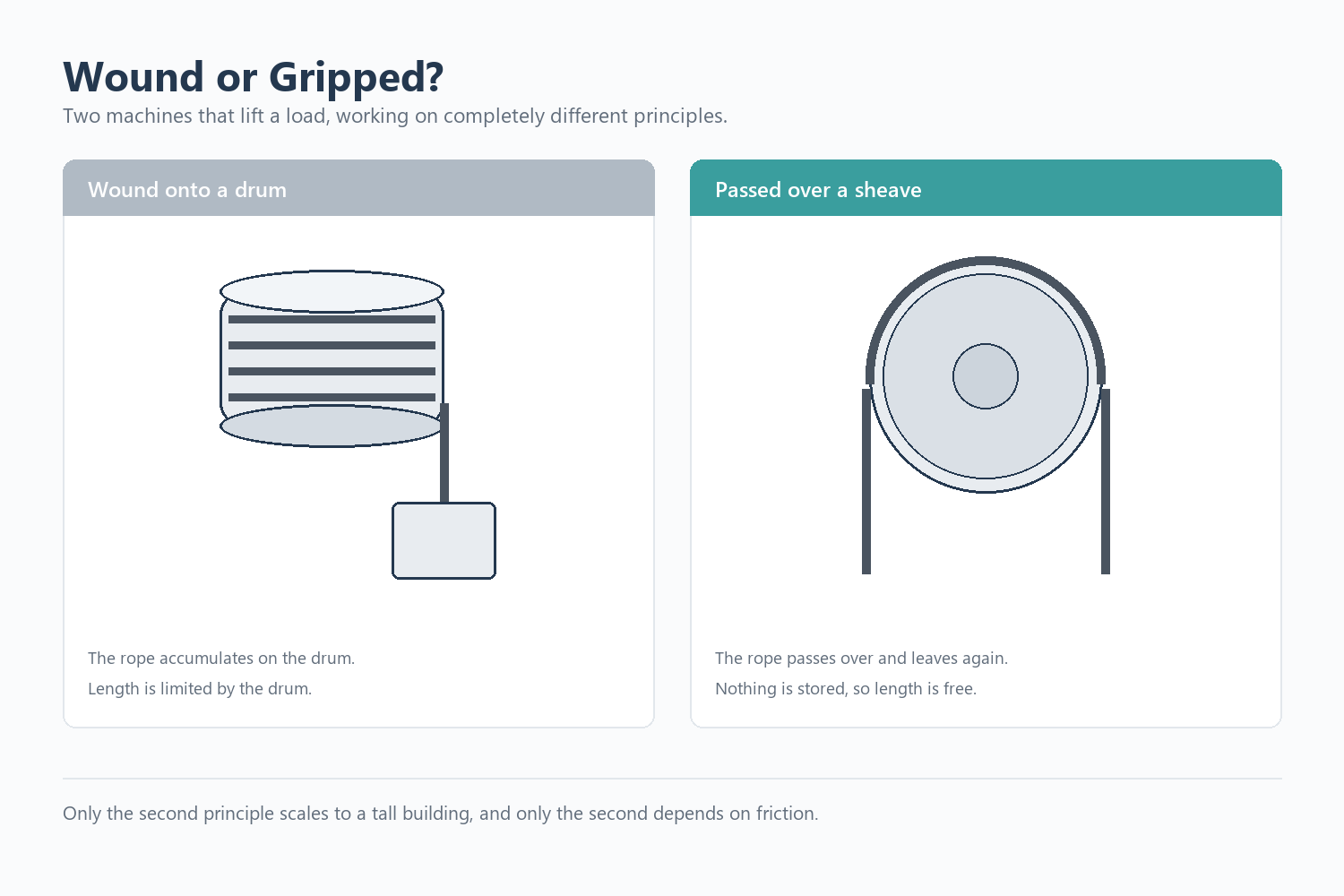
Most explanations of how an elevator traction machine works say the same thing: the motor turns a wheel, the wheel moves the ropes, the car goes up. That is true, but it skips the part that actually explains the machine.
A traction machine does not wind the ropes onto a drum. It grips them.
A traction machine does not wind the ropes onto a drum. It grips them.
How an Elevator Traction Machine Works
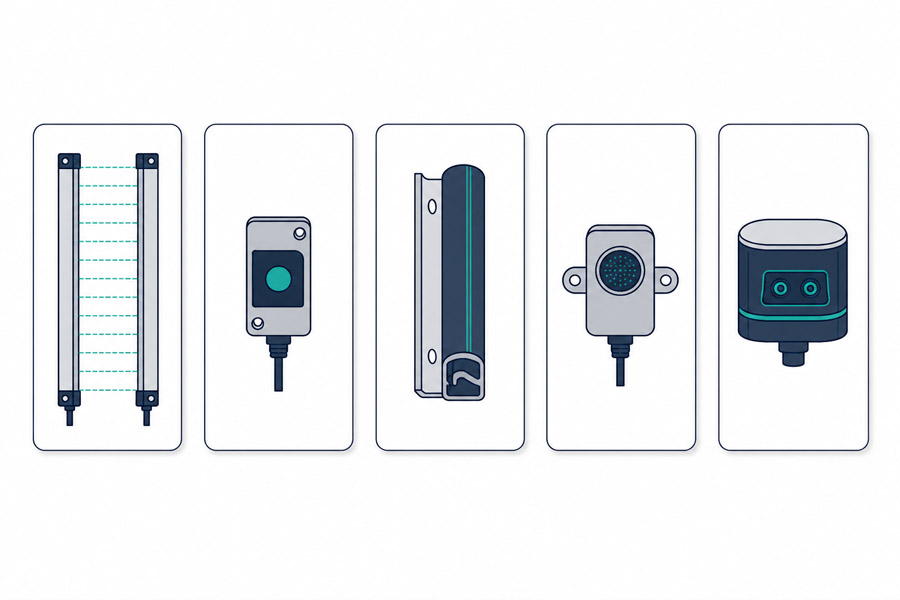
Elevator door sensor types fall into five groups: infrared light curtains, photo eyes, mechanical safety edges, ultrasonic sensors, and 3D sensors. This guide covers each type, how to identify the one you already have, and which to choose.
Elevator Door Sensor Types: How to Identify and Choose

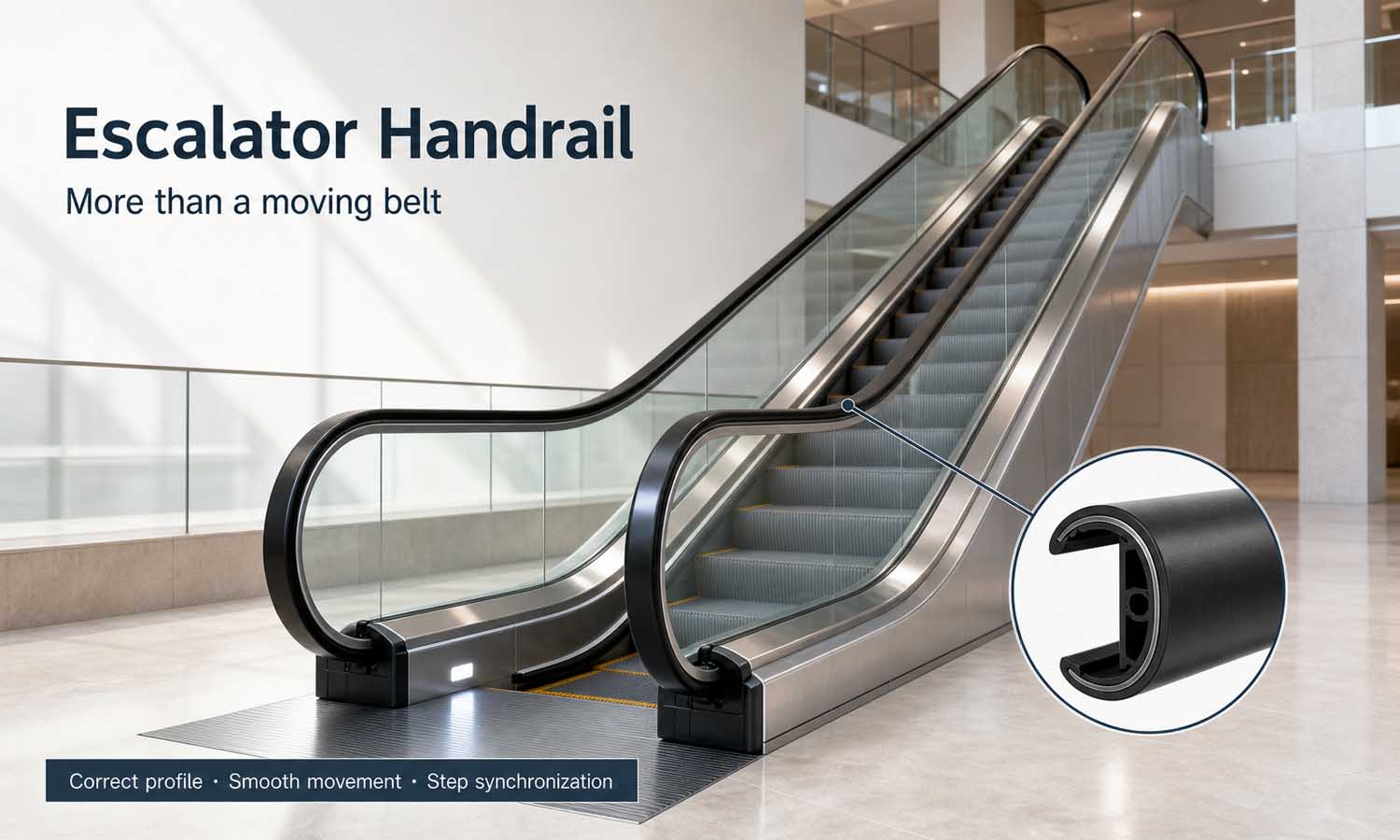
Escalator handrail replacement may be necessary for deep cracks, exposed reinforcement, permanent deformation, or serious joint damage. Dirt, minor surface marks, poor tracking, and speed differences do not always require a new belt. A qualified technician should first inspect the handrail and related components.
Escalator Handrail Replacement: When to Repair or Replace