Elevator Door Sensor Types: How to Identify and Choose
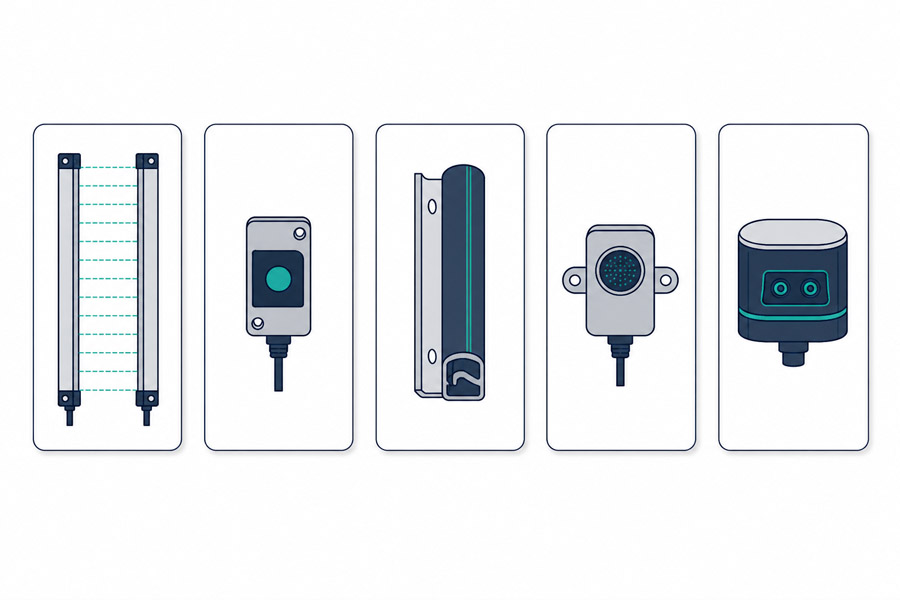
The light curtain is the modern standard. It is non-contact, covers the full door height, and reacts before anything touches the door. The other four are older designs, rare options, or newer high-end technology.
This guide covers each type, how to identify the one you already have, and which to choose.
The Main Elevator Door Sensor Types
| Type | How it detects | Contact needed | Where you see it |
|---|---|---|---|
| Infrared light curtain | Grid of infrared beams | No | Most modern elevators |
| Photo eye (photocell) | One or a few beams | No | Older and budget installations |
| Mechanical safety edge | Pressure on the door edge | Yes | Older elevators |
| Ultrasonic sensor | Sound waves | No | Rare |
| 3D / TOF sensor | Scans the area in front of the door | No | High-end and smart buildings |
Infrared Light Curtain
The most common type today. A transmitter bar on one side of the car door sends infrared beams to a receiver bar on the other, forming a dense grid across the full opening.
Modern curtains build that grid from many beams, from about 94 up to more than 230. In cross-beam designs the diodes fire at angles as well as straight across, so a single emission reaches several receivers. That is why a good curtain catches a thin leash or walking stick that a single beam would miss.
Beam spacing sets the resolution, usually 40, 48, 59, 84, or 118 mm. Smaller spacing means a denser grid and a smaller detectable object.
Choose it when: almost always. It is the default for new installations and modernization.
Photo Eye (Photocell)
A photo eye uses one beam, or a few, instead of a full grid. The principle is the same, but the protected area is a narrow line rather than a curtain.
The limitation is obvious. A hand or a small object can pass above or below the beam without triggering a reaction. Many older elevators still use photo eyes, and they are a common cause of complaints about doors closing on passengers.
Photo eyes cost much less than light curtains, but the price gap rarely justifies the safety gap.
Choose it when: the existing installation uses one and the budget is fixed. Otherwise upgrade.
Mechanical Safety Edge
A safety edge is a rubber or plastic strip along the door edge. Pressure from the closing door triggers the reversal.
This is a contact device. It must touch something before it reacts, which is the key difference from every other type here. Safety edges appear on older elevators, and some installations run one alongside a light curtain as a backup.
Choose it when: maintaining an older elevator built around this design. For modernization, move to a light curtain.
Ultrasonic Sensor
An ultrasonic sensor emits sound waves and reads the echo to detect objects near the door. It does not use light, so sunlight is never a problem.
This type is rare. Sound-based detection is disturbed by airflow, noise, and reflections inside a small car, which is one reason it never became standard.
Choose it when: replacing an existing ultrasonic unit and keeping the same interface. A light curtain is usually better.
3D / TOF Sensor
A 3D sensor uses time-of-flight measurement to scan the space in front of the doors, not just the flat plane across the opening. It can detect a passenger walking toward the elevator before they arrive.
These are used in high-end commercial buildings, airports, and hospitals, where doors should stay open for people still approaching. Many 3D systems work alongside a standard light curtain rather than replacing it.
Choose it when: traffic is high and the budget allows, or the project calls for smart building features.
How to Identify the Type You Already Have
You can usually tell without removing anything.
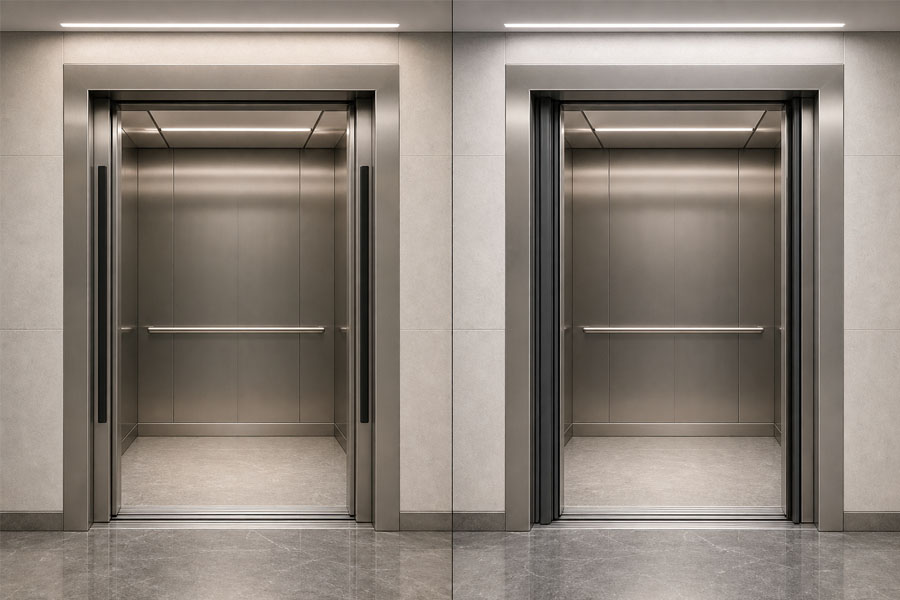
- Door edges. Two slim dark strips facing each other across the opening point to a light curtain. A rubber profile on the leading edge points to a safety edge.
- Height coverage. A light curtain covers the full opening. A photo eye sits at one height, often around hand level.
- Reaction. If the door reverses before anything touches it, the sensor is non-contact. If it touches you first, it is a safety edge.
- Car top. A separate power box means a light curtain with its own control box. No power box means the curtain is fed directly by the door operator.
- Output type. Relay outputs are marked NO, NC, or 1NO/1NC. Transistor outputs are marked NPN or PNP. This matters for any replacement.
The model label on the sensor bar or the door operator documentation will confirm it.
Which Type Should You Choose?
For most projects, an infrared light curtain. It is non-contact, covers the full door height, and is the type most door operators are built to accept.
Check these points before ordering:
- Protection height — measure the actual opening; the curtain must cover it fully
- Voltage — AC 220 V or DC 24 V
- Output type — relay or transistor, NO or NC, NPN or PNP
- Connection — direct connection or separate power box, plus the cable length needed
- Door type — central opening, side opening, or four-panel central opening; each uses a different cable configuration
- Environment — for doors facing direct sunlight, choose a model with higher light immunity
A photo eye, safety edge, or ultrasonic unit is only the right choice when the existing system is built around that design and you intend to keep it.
FAQ
What are the most common elevator door sensor types?
Infrared light curtains are the most common, followed by photo eyes and mechanical safety edges. Ultrasonic sensors are rare, and 3D sensors are growing in high-end buildings.
How do I know if my elevator has a light curtain or a photo eye?
Look at the coverage. A light curtain has bars on both sides covering the full opening height. A photo eye is a single small unit at one height, usually around hand level.
Can I replace a safety edge with a light curtain?
Often yes, but it is not a simple swap. A light curtain needs mounting points on both sides, a power supply, and an input on the door operator. Confirm the door operator can accept the new signal before ordering.
Conclusion
An elevator door sensor protects passengers in the door opening. The type you fit decides how early the door reacts, how much of the opening is protected, and how the sensor connects to the door operator.
For nearly all projects, an infrared light curtain is the right choice. The main exceptions are older elevators built around a photo eye or a mechanical safety edge, where the replacement must match the existing system.
If you need help identifying a sensor or matching a replacement, contact POTENSI. We supply elevator door sensors and light curtains for a wide range of door operators and elevator brands, and we can confirm the right type and specification before you order.
Escalator Handrail Replacement: When to Repair or Replace
Related Article